Why inferplane
Set the operating policy centrally; let each gateway apply it as requests arrive. inferplane combines a dedicated governance control plane with data planes that enforce model access, budget decisions, privacy boundaries and accounting. Coding agents use one gateway endpoint and approved model names while the configured rules determine which provider attempts are allowed.
The value is in how these controls work together: a cheaper route must still be private enough, an internal route must still fit the budget, and a fallback must still satisfy both.
From API access to governed execution
API normalization, routing and observability are useful gateway capabilities. Other gateways also provide budgets, guardrails or separate control and data planes; these are not exclusive claims. For example, the Envoy AI Gateway architecture describes separate planes, and LiteLLM's proxy architecture describes authentication, budgets and rate limits.
Evaluate inferplane on the following concrete operating contracts, rather than a feature-count comparison:
| Operating need | inferplane's design | What it means for your team |
|---|---|---|
| Manage policy without relaying every prompt through the management service | inferplaned distributes policy/authority; mayu carries inference and enforces decisions |
Deploy the gateway near agents or in a shared fleet while keeping control-plane HTTP out of each inference admission |
| Make one rule apply across clients | Matching GovernancePolicy rules constrain model access, rates, quotas, money and routing |
Supported ingresses share governance; users need not manually select a privacy route for each request |
| Change behavior before a total spending stop | Budget tiers select configured alternatives; optional strict targets constrain every attempt | Define an economy cutover separately from the hard cap |
| Keep sensitive requests inside approved destinations | Local inspection, InternalOnly, verified Mask, Block, and restricted fallback |
Privacy obligations survive context selection, budget switching and retries |
| Choose where shared accounting lives | Durable node-local money grants or synchronous shared Postgres admission | Select global money with local request admission, or shared keys/rates/tokens/money with an explicit DB dependency |
| Explain what actually happened | Routing evidence, per-attempt authority accounting, audit chains and metrics | Separate recommendations, actual provider attempts and uncertain spend |
These contracts are implemented mechanisms in an alpha product. Complete organization/team administration roles, full user-pool contracts and production qualification remain open. See the support matrix and readiness assessment.
Separate management from inference
The control plane sets the rules. The data plane applies them.
inferplaned distributes GovernancePolicy documents and budget authority,
receives usage telemetry, and can broker short-lived Bedrock credentials.
mayu authenticates requests, inspects supported content, resolves approved
routes, checks admission, calls providers and records usage.
Prompts and response streams do not transit the control-plane HTTP service. Local inspection and bounded session preferences need no remote classifier or affinity service. This gives operators separate management and inference deployment boundaries; it does not guarantee unlimited operation during an outage.
| Choose a profile | Request-time authority | Useful boundary |
|---|---|---|
Local mayu |
Local stores/counters, optionally local policy files | Evaluate one gateway without a control plane |
| Durable node-local money · ADR-045 | Private journal backed by finite centrally committed money grants | Govern policy money across managed machines without a shared DB call per inference request; keys/rates/token quotas stay local |
| Shared Postgres · ADR-046 | Synchronous key lookup and atomic rate/token/money reservations | Apply shared admission across gateways; reachable Postgres is required |
Existing node-local credit is usable only within readiness, policy-age and authority deadlines; control-plane or authority-DB loss prevents replenishment. Shared mode refuses new admission on DB loss. The architecture diagram shows each dependency; deployment profiles specify the outage contracts.
Configure the rules. The gateway applies them.
Automation starts with explicit operator choices. It does not discover your data boundary, invent a budget, or automatically approve a model.
| You configure | mayu automatically applies | Boundary to retain |
|---|---|---|
| Virtual keys, allowed models, team/user policy selectors; optional verified identity | Authenticates and evaluates applicable restrictions | A model substitution cannot widen access; full management-role and user-pool models remain open |
| Provider targets, prices, context windows and capabilities | Resolves public model names and filters incompatible routes | Declared metadata must match the actual deployment |
| PII actions and explicit internal model names | Inspects original supported content; routes internally, masks and reinspects, or blocks | Finite detectors; unknown/opaque input follows onUninspectable; an internal label is an operator assertion |
| Budget reference, thresholds and substitutes | Changes the effective route as the configured usage threshold is reached | Enable enforceTargets for strict cutover; legacy substitution can retain the original model |
| An independent hard cap and accounting profile | Checks before billable egress; authority profiles reserve every attempt and settle observed usage | Cheap/internal routes still consume the cap; incomplete usage can retain the reservation |
| Context targets, thresholds, keywords and optional stability | Recommends in Shadow; selects compatible routes in Enforce and revalidates local successful-target preferences | Rule-based signals do not prove task difficulty or model quality; context cannot loosen privacy or strict targets |
| Audit sinks and monitoring | Records decisions, attempts, usage and refusals | Analytics are not the budget authority; body capture is separate and opt-in |
Policy distribution and application are asynchronous. A new policy is not an instantaneous fleet-wide transaction. Configure synchronization/staleness gates and understand issued authority before changing operating limits.
One configuration, several automatic decisions
The repository includes an
adaptive gateway configuration and
governance policy.
The example uses an engineering team, an auto model alias, internal economy
targets, a $100 monthly switching threshold, and a separate $150 monthly
hard cap. Amounts, endpoints, prices and model IDs are illustrative.
Establish the operating policy
- Replace provider endpoints/model IDs, verify internal processing boundaries, and declare real capabilities, context windows and accounting prices. Supply the example's referenced secrets through your secret manager.
- Load the governance policy with one of internal routing or masking. The supplied gateway config selects internal routing. Loading both requires both masking and an internal destination.
- Connect the client to mayu and issue an allowed virtual key. Keep using
autofor requests compatible with the configured target protocols and capabilities. - Evaluate context recommendations in Shadow, then explicitly set
routing.context.mode: Enforceif workload results justify automatic selection. Privacy and strict budget routing do not wait for this context toggle. - For fleet accounting, follow the chosen
durable or shared profile.
Replace the local
policiessource withcontrol_plane; the two sources are mutually exclusive. Configure the corresponding authority/state stores too.
See adaptive routing for the commands and complete compatibility requirements.
Observe the request decisions
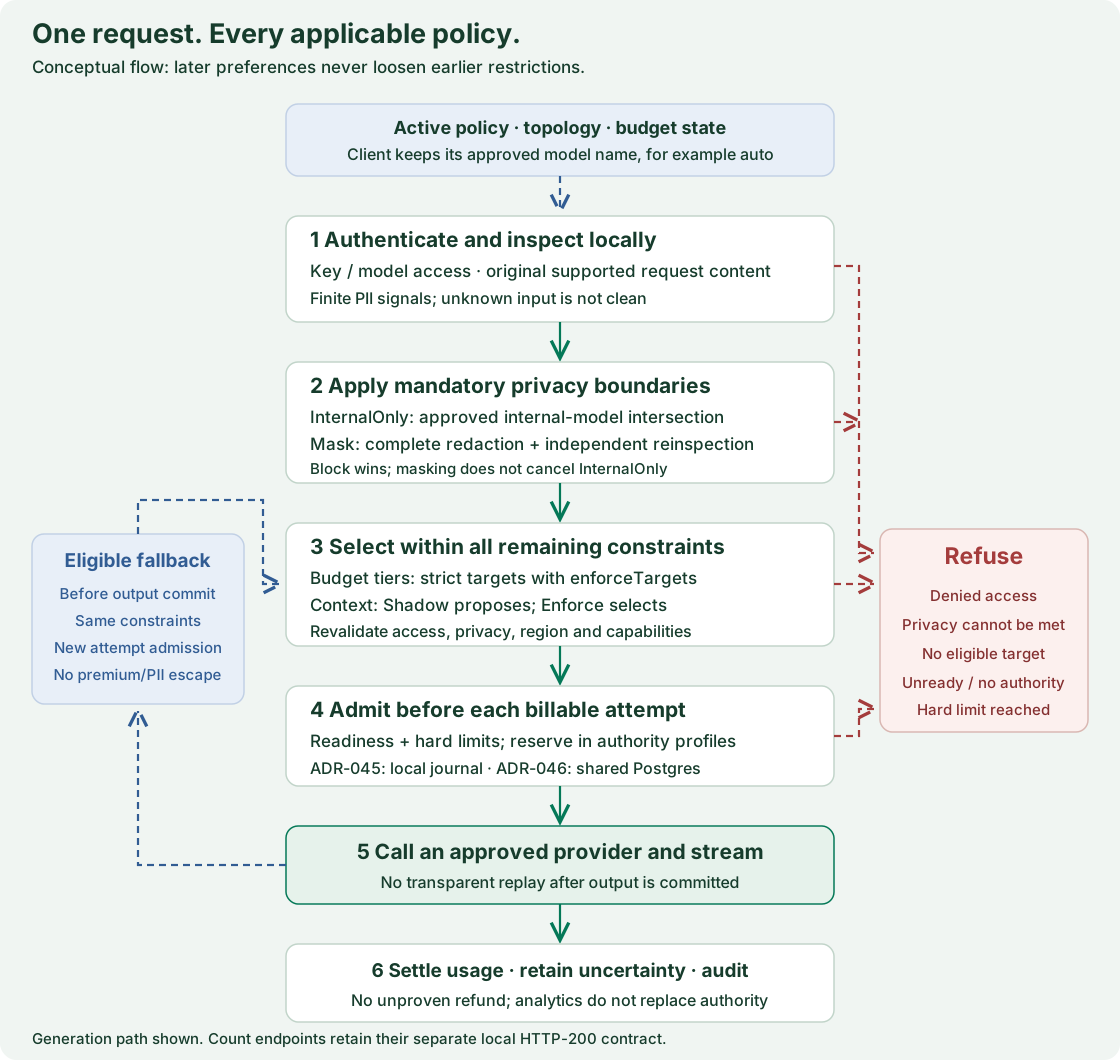
Open the decision-flow diagram. This is a conceptual decision flow; constraints compose, rather than letting a later stage override an earlier restriction. Ingress adaptation and readiness gates remain protocol-specific.
| Example request or event | Automatic result under the example policy |
|---|---|
Ordinary inspectable auto request below the switching threshold |
Shadow records a context recommendation while retaining the baseline route; Enforce may select a compatible weak/normal/strong target |
| A supported email/phone/card or other covered PII signal | InternalOnly restricts the request to approved internal economy targets, subject to access, capabilities and admission |
| Detected PII when using the alternative masking policy | Mayu completes masking and independent reinspection before any usable route; unsafe transformation refuses |
| Opaque or uninspectable input | The example's onUninspectable: Block refuses generation |
| The $100 switching threshold becomes active | enforceTargets: true constrains mapped model names to economy, including subsequent eligible retries; a conflicting privacy rule or unavailable target can refuse |
| The remaining $150 hard-cap allowance cannot admit the next attempt | Refusal before billable egress, even for the economy/internal route |
| An approved provider fails before the supported output-commit boundary | An eligible fallback must pass the same privacy/access/strict-target checks and new attempt admission; no unrestricted external or premium escape |
| A stream ends with incomplete usage | Authority accounting retains unproven spend; observed usage and uncertainty remain distinct |
A cutover is evaluated from the profile's accounting state; it is not an exact external-invoice threshold or a promise to interrupt already-running requests. Reservations can refuse a request before the displayed settled spend reaches the hard cap. Model/provider switches can also lose cache warmth. Evaluate total settled cost, retries, latency and task success before claiming savings.
What the automation does not decide for you
PII inspection covers finite email, supported phone, card, SSN, IPv4 and Korean resident-ID shapes. It does not establish universal PII discovery, regional legal compliance or provider trust. Internal targets must really meet the processing boundary you declare. If a safe route cannot be established, restrictive privacy rules refuse rather than letting context or cost preferences relax the boundary.
False positives, missed or obfuscated values, and uninspectable content remain possible. Protected structural fields can also prevent safe masking. See the inspection contract and masking limits before choosing the policy for your workload.
Network controls and provider credentials determine whether users can bypass your gateway. A node controlled by an adversary is not made trustworthy by installing mayu or enabling credential brokering. Operators also own HA database deployment, recovery qualification and model quality evaluation.
Start with the local quickstart, select an accounting profile, and use the security boundaries and production readiness pages to define your pilot.