Architecture
System Overview
inferplane separates inference traffic from policy administration. mayu
authenticates and routes requests, enforces configured controls, and records
usage. inferplaned distributes policy and budget authority, aggregates usage,
and optionally brokers short-lived Bedrock credentials. Both are static Go
binaries; a standalone mayu needs no control plane.
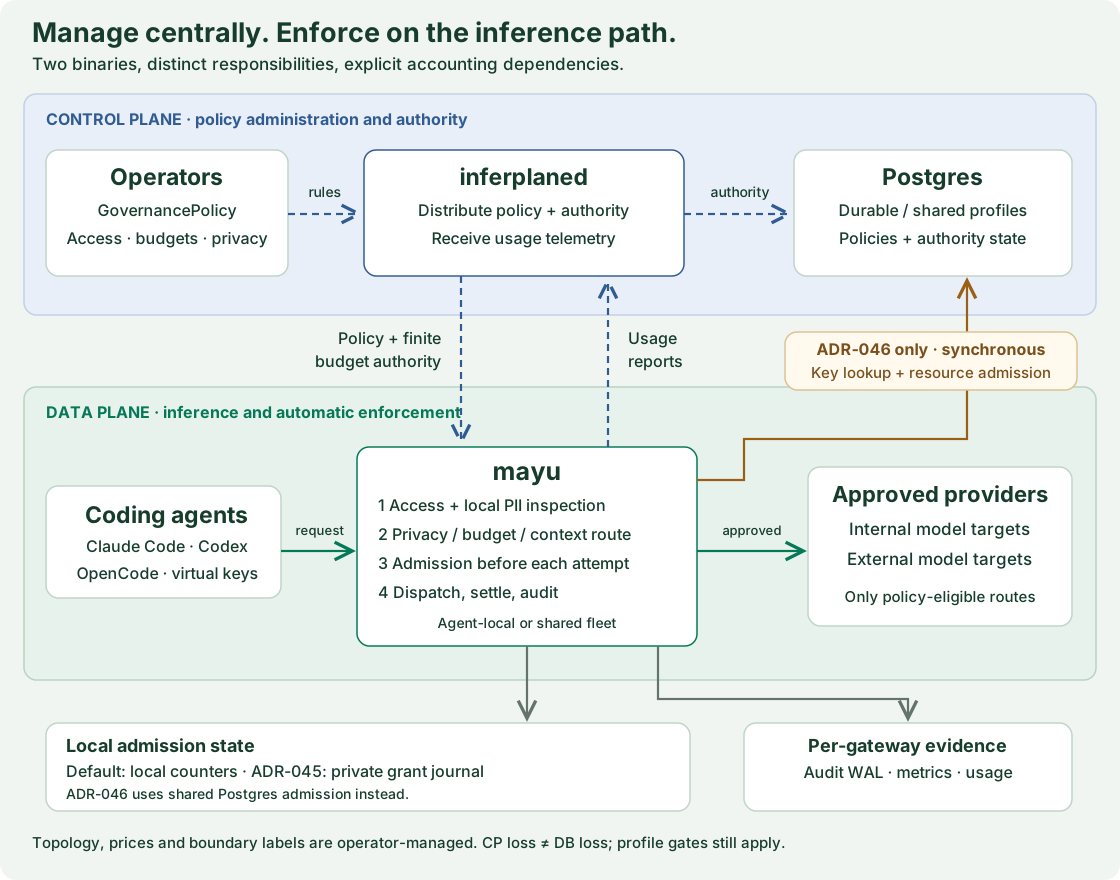
Solid green arrows carry inference; dashed blue arrows carry policy, authority or usage synchronization. The amber edge is synchronous shared-DB access, only for ADR-046. Prompts and response streams stay on the agent → mayu → provider path. Usage telemetry returns separately to the control plane.
The control-plane HTTP service is not called for each inference admission. Dependencies still vary by deployment profile: local enforcement uses process-local counters; ADR-045 uses centrally committed monetary grants and a private local journal; ADR-046 synchronously resolves keys and reserves resources through Postgres. This separation is not an unconditional availability guarantee.
How configuration becomes automatic enforcement
Operators declare model/provider topology, processing boundaries, capabilities,
prices and referenced credentials on the data plane. GovernancePolicy supplies
matching subject rules for model access, rates, quotas, budgets and routing.
A gateway reads either watched local policies or an attached
control_plane; configuration rejects both together. Central policy distribution
does not automatically deploy provider topology or verify an internal destination.
With a control plane, policy and authority synchronization runs outside the inference request. The gateway validates and installs the applicable state, subject to first-sync, staleness, identity and profile-specific authority gates. Changes propagate asynchronously, rather than atomically across every gateway.
On each generation request, mayu combines the installed policy with current key access, request inspection and budget state. Configured PII actions, budget cutover and context preferences become routing decisions without the client choosing each transition. Context is Shadow unless explicitly enabled; privacy and strict budget targets still enforce. See the configuration-to-decision walkthrough.
The architectural benefit is a separate management lifecycle plus local request inspection and enforcement. It does not eliminate storage or credential dependencies: ADR-045 can spend only existing valid grants during CP/DB loss; ADR-046 requires reachable Postgres on each admission. The profile outage table defines when generation continues or refuses.
Components
Ingress Layer (internal/server)
Messages, Chat Completions, Responses, and Bedrock-shaped generation routes share identity, body-size, readiness, access and governance controls. Model discovery and usage views are authenticated. Count endpoints preserve their HTTP-200 contract, including local estimates when generation would be refused. See the HTTP reference for routes and protocol limits.
The separate admin listener serves health, readiness, metrics, authenticated management APIs and a data-free console shell. OIDC and static-token paths have different identity/authorization contracts; the complete six-role org/team model remains open.
Governance Layer (internal/governance, internal/authority)
| Profile | Admission state | Failure boundary |
|---|---|---|
| Local SQLite / optional legacy CP | Process-local rate, quota and money; legacy CP allowances | Local counters reset on restart; attached readiness/lease gates still apply |
| Durable node-local money · ADR-045 | Postgres policy-money authority, finite grants, private node journal | Existing credit only within readiness/staleness and hard deadlines; no replenishment during CP/DB loss |
| Shared Postgres · ADR-046 | Shared key/team snapshots and atomic rate/token/money reservations | New key resolution/admission requires reachable Postgres and valid policy binding |
Governance checks precede billable egress. Authority profiles reserve a conservative bound for each provider attempt. Settlement records known usage and retains uncertainty where a refund cannot be proved. Expiry, a lost node, or an interrupted stream does not create fresh credit. Monetary arithmetic uses integer microUSD and round-half-even; pricing is an operator-reviewed accounting input, not a guarantee about an external invoice.
The local profile also reserves money per attempt (ADR-054). Outstanding liability prevents overlapping requests from multiplying one-request overshoot. Interrupted or unpriceable results retain credit until the calendar window ends; known spend and unresolved liability remain separate. These counters remain process-local and reset on restart.
Provider Layer (providers/*)
| Package | Responsibility |
|---|---|
anthropic |
Messages protocol and server-side credential injection |
bedrock |
Configured InvokeModel, Converse or Mantle paths; AWS signing and API-specific limits |
bedrockresponses |
Native Bedrock Responses transport with AWS credential/signing integration |
openaicompat |
Chat Completions-compatible upstreams |
openairesponses |
Native Responses upstreams |
The provider interface is the extension boundary. Protocol-compatible paths preserve raw request bodies under the existing forwarding contract; deliberate model rewrites, enabled masking and cross-protocol translation have separate semantics. Declared capabilities do not prove universal tool/reasoning support. Unsupported guardrail/API combinations refuse rather than silently bypassing the control. See provider reference.
Routing Layer (internal/router, internal/sensitivity, internal/tier)
Ingress JSON parsing is required. Additional routing inspection is conditional: Messages, Chat and Bedrock InvokeModel skip it without applicable privacy/context rules or strict budget targets; Responses always uses it for transport compatibility. Native Bedrock Converse also always inspects structure before admission. Structural mode skips finite PII detectors when only context, strict targets or unprotected compatibility needs inspection. Effective privacy and independent masking reinspection require full detection evidence (ADR-055). Learned classification and legacy masking are separate opt-ins. See inspection conditions.
Routing composes public model resolution, allowed targets, budget tiers, sensitive-data decisions, context selection, and provider fallback. Every attempt must satisfy access, privacy, region, capacity and active strict-target constraints. Legacy optional tier substitution retains the original model when an alternative cannot be used; opt-in strict targets can refuse. Context Shadow still enforces privacy. Session stability is bounded and local, not a shared session authority.
Fallback is limited by the ingress/provider's pre-commit streaming boundary. Once output has been committed, a failed stream cannot be replayed transparently. See policy routing and adaptive routing.
Persistence Layer (internal/keystore, internal/authority, internal/audit)
SQLite is the default hashed-key/team store. The shared profile implements a Postgres key/team backend and shared resource admission. Optional verified human/service identity uses a persistent registry while retaining registered financial account references; activation is explicit, not a side effect of choosing Postgres.
Postgres can also store policy documents and usage/analytics. The mutable provider topology store remains SQLite-only and is rejected in shared governance mode. Private ADR-045 journals and per-instance audit WALs must never be shared between running gateways. See data reference and verified identity.
Observability Layer (internal/metrics)
Prometheus serves bounded gen_ai_* and inferplane_* metrics on the admin port.
Opt-in traces use OTLP. Audit records use an exact-byte hash chain with per-instance
segments and optional external anchors. Body capture is a separate opt-in
encrypted store; it is not part of the audit chain.
Control-Plane Telemetry (internal/telemetry, internal/controlplane, ADR-036)
Usage windows travel to POST /v1alpha1/usage separately from policy/authority
synchronization. They support analytics and the usage console; they are not OTLP
and are not a substitute for the authority ledger. Analytics delivery loss and
retained monetary uncertainty are different operating conditions.
Security Layer (cross-cutting)
Virtual-key hashes, upstream credential isolation, referenced secrets, bounded metrics and fail-closed control paths protect the configured gateway boundary. Policy administration and credential brokering have dedicated credentials. A compromised host can still obtain locally accessible credentials or sessions; provider boundary labels and identity fingerprints are not host attestation. See security boundaries.
Request decisions inside mayu
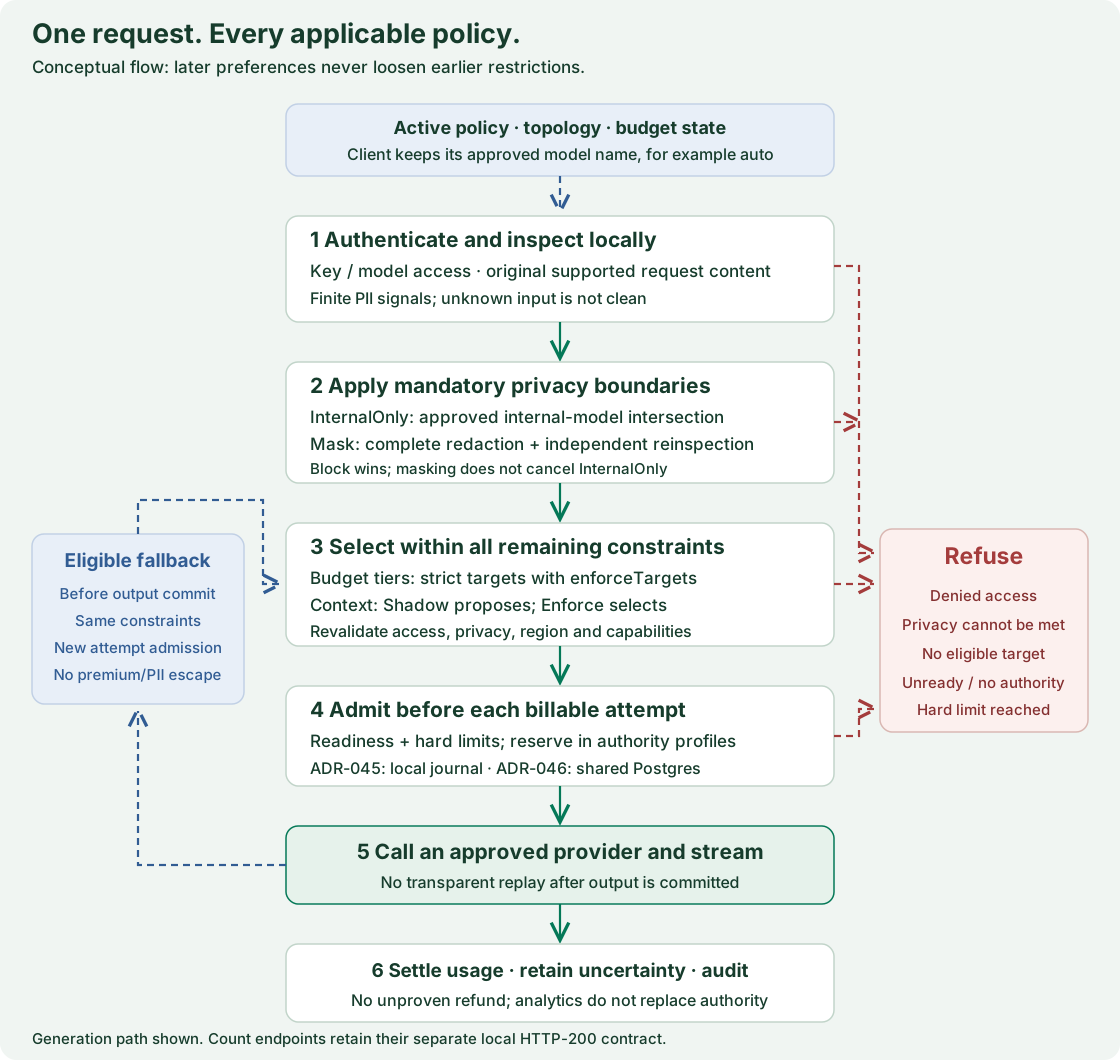
Open the decision-flow diagram
This diagram describes combined decisions, not a promise that every ingress handler executes identical functions in this exact order. Access, privacy, capability, region and active strict-budget restrictions apply to every target. Context and cache preferences operate only within that eligible set.
For InternalOnly, the model must belong to the allowed internal-model
intersection and the provider must carry a compatible internal boundary.
Mask requires complete transformation and independent reinspection before a
usable chain is returned; it never cancels a separate InternalOnly obligation.
Block wins. If no compatible target remains, the request refuses.
With enforceTargets: true, an active budget tier constrains attempts to its
configured target. It is separate from hard-cap admission and cannot buy more
credit. Legacy optional substitution instead retains the original model when the
alternative is unusable. Every authority-backed attempt reserves its own bound,
including an allowed retry. A partial stream or unproven cost does not create a
refund.
Data Flow Summary
- Authenticate the virtual key and establish its current principal/identity.
- Parse and bound the request; retain the protocol representation needed for supported forwarding or conversion.
- Resolve routing and enforce access, privacy, region and capability constraints.
- Apply readiness/governance checks and reserve any required authority before each billable provider attempt.
- Dispatch and stream under the selected protocol; preserve terminal failures.
- Settle observed usage, retain unresolved liability, and emit audit/telemetry.
This is a conceptual sequence; ingress-specific protocol adaptation remains in the corresponding handlers. A later fallback cannot widen an earlier restriction.
Infrastructure
Deployment
Each Dockerfile builds a static binary into a non-root distroless image. The Helm chart renders config and references an existing Secret. Local mode allows one gateway replica. Explicit shared mode supports multiple gateways; persistent shared mode supplies separate audit PVCs, anti-affinity and a disruption budget. Postgres HA, TLS, network controls, resource sizing and recovery qualification are operator responsibilities. See container and Helm deployment.
Modules / Resources
| Component | Path | Role |
|---|---|---|
| Data plane | cmd/mayu |
Thin assembly and operator CLI |
| Control plane | cmd/inferplaned |
Policy, authority, telemetry and optional broker assembly |
| Policy schema | internal/policy, api/v1alpha1, deploy/crd |
Shared rules and versioned contracts |
| Helm chart | charts/inferplane |
Profile-aware gateway manifests |
| Monitoring | deploy/grafana/inferplane.json |
Starter dashboard |
Deployed Endpoints
The gateway defaults to data port 8080 and admin port 9090; production exposure is
explicit. inferplaned defaults to port 7601. See API reference
and the infrastructure reference.
SIGHUP reloads supported provider/model/pricing topology atomically. Listen, backend, identity declaration, node/journal and authority-mode changes require restart. A failed reload retains the previous valid topology.
Key Design Decisions
- Profile-specific authority defines accounting and outage behavior.
- Canonical conversion supports compatible cross-protocol requests; raw forwarding preserves supported same-protocol semantics.
- Admission precedes billable egress; each retry carries its own obligation.
- Uncertain usage remains unavailable until supported recovery can establish it.
- Audit fields evolve additively so old exact-byte records still verify.
- Working mechanisms remain alpha pending production qualification.
Operations
Start with monitoring, upgrade and recovery, and security. Architectural history lives in the decision records; package details live in the implementation reference.